
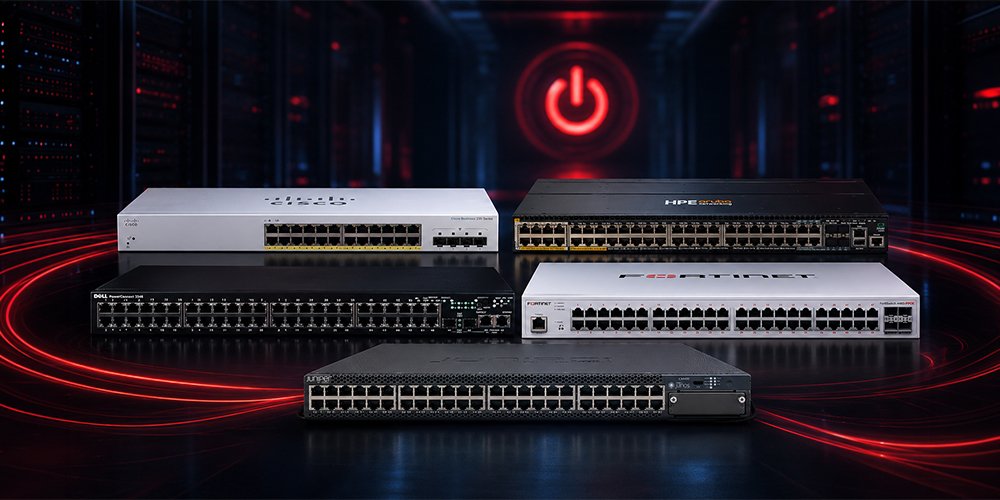
Network switches are one of the most important components of any business IT infrastructure. They connect users, servers, wireless access points, IP phones, printers, cameras, storage systems, firewalls, and other network devices, allowing data to move efficiently across the organization.
CITS provides professional network switches in Egypt for businesses of all sizes. Our switching solutions help organizations build stable, secure, scalable, and high-performance networks that support daily operations and future growth.
We work with leading network switch manufacturers, including Cisco, HPE, Dell, Fortinet, and Juniper. This allows us to offer different switching options according to the customer’s network size, performance requirements, security needs, number of users, applications, and budget.
Our team has extensive experience in designing, implementing, and maintaining network switching infrastructure for offices, branches, server rooms, data centers, educational institutions, healthcare facilities, factories, hospitality environments, and enterprise networks.
Whether you need access switches for users, PoE switches for wireless access points and IP phones, core switches for high-speed backbone connectivity, or advanced switching solutions for data centers, CITS can help you select and implement the right solution.
Professional Network Switching Solutions for Businesses
A business network depends on switches to connect devices and manage traffic between different parts of the infrastructure. If the switching layer is weak, outdated, poorly configured, or overloaded, the entire network may suffer from slow performance, disconnections, security issues, and limited scalability.
CITS provides switching solutions that support different business requirements, including:
- Office network connectivity
- LAN switching
- WAN switching
- Server room connectivity
- Data center switching
- Wireless access point connectivity
- IP telephony and voice networks
- CCTV and surveillance systems
- Access control systems
- Storage and backup connectivity
- Branch network connectivity
- Network segmentation
- High-speed backbone links
- Business application performance
- Secure network access
Our approach starts by understanding the customer’s infrastructure. We evaluate the number of users, connected devices, applications, server requirements, cabling system, wireless network, security policies, and future expansion plans before recommending the most suitable switching solution.
Why Network Switches Are Important
Network switches are responsible for forwarding data between devices inside the business network. They help ensure that users can access shared files, business applications, printers, internet services, servers, storage systems, and other resources.
A reliable switching infrastructure can improve:
- Network speed
- Device connectivity
- Application performance
- User productivity
- Wireless network stability
- Voice and video quality
- Security segmentation
- Network management
- Infrastructure scalability
- Troubleshooting efficiency
Modern switches also provide advanced features such as VLANs, Quality of Service, Power over Ethernet, link aggregation, redundancy, monitoring, access control, and centralized management.
These features help businesses create a more organized and controlled network environment.
LAN Switching Solutions
Local Area Network switching connects devices inside the same office, building, branch, or business location.
CITS provides LAN switching solutions for companies that need stable connectivity between users, workstations, servers, printers, access points, IP phones, cameras, and other internal devices.
A proper LAN switching design helps support smooth internal communication and improves the performance of daily business applications.
LAN switching may include:
- Access switches for users and devices
- Distribution switches for connecting network sections
- Core switches for high-speed backbone connectivity
- VLAN configuration
- PoE support
- Quality of Service configuration
- Redundant links
- Link aggregation
- Network monitoring
- Port security
Cisco LAN switches, HPE switches, Dell switches, Fortinet switches, and Juniper switches can all be used depending on the organization’s requirements and existing infrastructure.
WAN Switching and Branch Connectivity
Many organizations operate across multiple branches, departments, remote sites, or business locations. These environments require secure and reliable connectivity between sites.
CITS provides WAN switching and branch network solutions that help connect remote locations to the main network.
WAN switching solutions may be used to support:
- Branch-to-head-office connectivity
- Remote office access
- Multi-site business operations
- Centralized applications
- Data sharing between locations
- Secure communication
- Business continuity
- Network traffic management
HPE WAN switching and other enterprise switching solutions can help businesses connect remote sites while maintaining reliable performance and controlled access.
The right design depends on the number of locations, bandwidth requirements, applications used between sites, security policies, and redundancy needs.
PoE Switches for Wireless, IP Phones, and CCTV
Power over Ethernet, commonly known as PoE, allows network switches to deliver both data and electrical power through the same Ethernet cable.
PoE switches are especially important for devices such as:
- Wireless access points
- IP phones
- IP cameras
- Access control devices
- Time attendance systems
- Some IoT devices
Using PoE can simplify installation because devices do not always require a separate power outlet near their location.
For example, wireless access points installed on ceilings and IP cameras installed in different building areas can receive power directly from the network switch.
CITS helps businesses select PoE switches based on the number of powered devices, required power budget, cabling infrastructure, switch capacity, and future expansion plans.
Managed Switches for Business Networks
Managed switches provide advanced control and visibility over the network.
Unlike basic unmanaged switches, managed switches allow IT teams to configure settings, monitor performance, create VLANs, control access, prioritize traffic, and troubleshoot issues more effectively.
Managed switches can support features such as:
- VLANs
- Port security
- Quality of Service
- Link aggregation
- Network monitoring
- Access control
- Redundancy protocols
- Traffic management
- SNMP monitoring
- Centralized administration
- Firmware updates
- Event logging
For most business environments, managed switches are recommended because they provide stronger control, better security, and more flexibility.
CITS can help configure managed switching environments according to the business network design and operational requirements.
VLANs and Network Segmentation
VLANs allow businesses to divide the network into separate logical segments.
Instead of allowing every device to communicate freely with every other device, VLANs help separate departments, users, servers, guest networks, cameras, voice systems, and management interfaces.
Network segmentation can improve security, simplify management, and reduce unnecessary traffic across the network.
Examples of VLAN segmentation include:
- Employee network
- Guest network
- Voice network
- CCTV network
- Server network
- Management network
- Finance department
- HR department
- Wireless users
- IoT devices
CITS designs and configures VLANs based on the organization’s departments, systems, applications, and security policies.
Proper VLAN design should also be integrated with firewalls, routers, wireless controllers, and access control rules.
Quality of Service for Voice and Video
Some types of network traffic are more sensitive to delay than others.
Voice calls, video meetings, conferencing systems, surveillance streams, and business-critical applications may require priority over general internet browsing or file downloads.
Quality of Service, or QoS, allows the network to prioritize important traffic so that sensitive applications can perform more reliably.
Cisco LAN switches and many other enterprise switching platforms can support QoS features depending on the selected model and configuration.
CITS helps businesses configure QoS policies based on the applications used inside the organization, such as IP telephony, video conferencing, cloud communication tools, and internal systems.
Core, Distribution, and Access Switching
A scalable business network is often designed using different switching layers.
Access Switches
Access switches connect end-user devices such as computers, printers, IP phones, access points, and cameras. They are typically installed in network racks across floors or departments.
Distribution Switches
Distribution switches connect multiple access switches and help organize traffic between different network areas. They may also enforce routing, security, and redundancy policies.
Core Switches
Core switches form the high-speed backbone of the network. They are designed to move large volumes of traffic between major network sections, server rooms, data centers, and distribution layers.
The right switching architecture depends on the size of the organization, number of users, connected devices, building structure, and performance requirements.
CITS can help design a switching architecture that supports the current business environment while allowing for future expansion.
Data Center Switching
Data centers require high-speed, reliable, and carefully designed switching infrastructure.
Servers, storage systems, firewalls, backup devices, virtualization platforms, and business applications all depend on strong network connectivity.
CITS provides data center switching solutions for organizations that need reliable performance, redundancy, scalability, and efficient traffic management inside server rooms and data center environments.
Data center switching may include:
- High-speed core switches
- Redundant switch architecture
- Server connectivity
- Storage connectivity
- Virtualization network support
- Link aggregation
- Fiber uplinks
- Network segmentation
- Monitoring and management
- Integration with security solutions
The switching solution should be designed according to server workloads, storage systems, virtualization requirements, application traffic, and availability targets.
Cisco Switches in Egypt
Cisco switches are widely used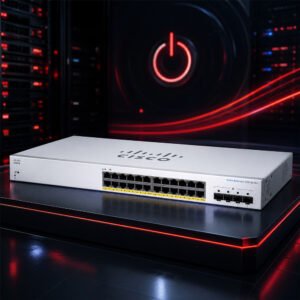 in business and enterprise networks because they offer a broad range of switching options for different environments.
CITS provides Cisco switches in Egypt for LAN connectivity, core networks, access layers, data centers, PoE requirements, and enterprise infrastructure.
Cisco switching solutions can support features such as VLANs, QoS, PoE, advanced management, security controls, and high-speed connectivity depending on the selected model.
Our team helps businesses choose the suitable Cisco switch configuration based on the number of users, ports, network speed, application requirements, and future growth plans.
HPE Switches in Egypt
HPE switches can support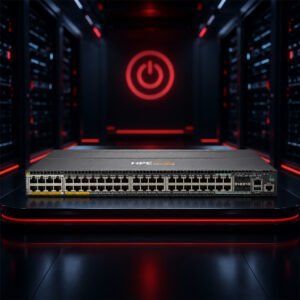 business networks, branch connectivity, enterprise environments, and high-performance infrastructure requirements.
CITS provides HPE switches in Egypt for organizations that require reliable access switching, WAN connectivity, managed network infrastructure, and scalable performance.
HPE switching solutions may be suitable for offices, campuses, branches, and data center environments depending on the required specifications and architecture.
Our team evaluates the customer’s network environment before recommending the appropriate HPE switching solution.
Dell Switches in Egypt
Dell switches can be used in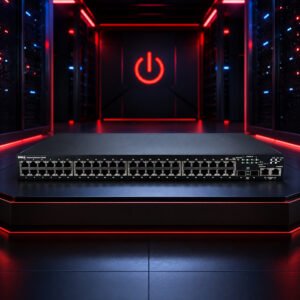 business networks, server rooms, data centers, and infrastructure environments that require dependable connectivity.
CITS provides Dell switches in Egypt for access networks, distribution layers, data center connectivity, and integration with servers and storage systems.
Dell switching solutions can be considered when organizations need flexible network connectivity with scalable performance.
Our specialists help customers select suitable Dell switches based on port requirements, uplink speed, network design, and integration with existing infrastructure.
Fortinet Switches in Egypt
Fortinet switches can provide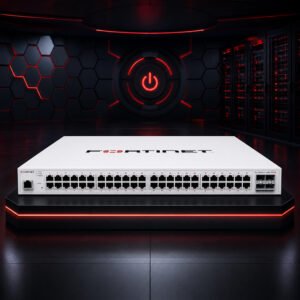 network connectivity while integrating closely with Fortinet security solutions.
CITS provides Fortinet switches in Egypt for organizations that require secure switching, centralized management, and integration with Fortinet firewalls and security policies.
Fortinet switching solutions may be suitable for businesses that need better visibility and control across users, devices, access points, and network segments.
Our team helps configure Fortinet switches according to VLANs, access policies, security zones, and business requirements.
Juniper Switches in Egypt
Juniper switches can support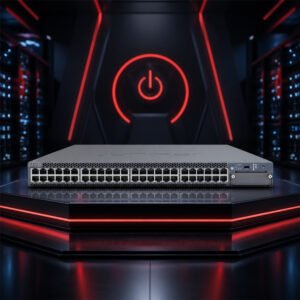 enterprise networks, data centers, service provider environments, and organizations requiring scalable network infrastructure.
CITS provides Juniper switches in Egypt for businesses that need advanced switching, SDN capabilities, secure connectivity, and flexible network design.
Juniper SDN switching can help organizations improve network flexibility, automation, and infrastructure efficiency when the environment requires advanced control.
CITS helps evaluate whether Juniper switching is suitable based on the customer’s network architecture, technical requirements, and operational goals.
SDN Switching Solutions
Software-Defined Networking, or SDN, separates network control from traditional hardware-based management. This can help organizations manage network behavior more flexibly through software-based control.
SDN switching may be suitable for businesses with complex environments, data centers, multiple applications, or infrastructure that requires automation and centralized control.
Potential benefits of SDN switching may include:
- Greater network flexibility
- Centralized management
- Faster configuration changes
- Improved automation
- Better visibility
- Easier policy enforcement
- Reduced operational complexity in advanced environments
CITS can help businesses evaluate and implement SDN switching solutions when they are suitable for the organization’s technical and operational requirements.
Switching for Wireless Networks
Wireless networks depend heavily on switches.
Each business access point usually connects back to a network switch. Many access points also require PoE to receive power through the same network cable.
If switches are not properly selected or configured, the wireless network may suffer from poor performance, limited capacity, unstable access point connections, or VLAN issues.
CITS helps businesses select switching solutions for wireless networks based on:
- Number of access points
- PoE power requirements
- VLAN configuration
- Controller integration
- Internet bandwidth
- User capacity
- Guest network requirements
- Security policies
- Future expansion
Switching and wireless should be planned together to ensure stable connectivity.
Switching for CCTV and IP Telephony
Modern CCTV and IP telephony systems often rely on network switches.
IP cameras, NVR systems, IP phones, call managers, and related devices need stable connectivity and may require PoE.
CITS helps organizations design switching infrastructure for CCTV and IP telephony systems, considering the number of devices, power requirements, bandwidth, VLAN separation, and QoS policies.
For IP phones, QoS configuration can help prioritize voice traffic. For CCTV, switch capacity and uplink speed should be planned according to camera resolution, recording requirements, and storage destination.
Network Switch Installation and Configuration
CITS provides complete network switch installation and configuration services in Egypt.
Our services can include:
- Network assessment
- Switch selection
- Rack installation
- Switch configuration
- VLAN setup
- PoE configuration
- QoS configuration
- Uplink configuration
- Link aggregation
- Management settings
- Security policies
- Integration with firewalls
- Integration with wireless access points
- Testing and troubleshooting
- Documentation
- Maintenance and technical support
Correct configuration is essential for achieving stable performance and secure network operation.
A switch should not only be connected physically. It should be configured according to the organization’s users, departments, applications, security requirements, and future expansion plans.
Network Switch Maintenance and Support
CITS provides support and maintenance services to help keep business networks stable and operational.
Switch maintenance may include reviewing configurations, troubleshooting port issues, replacing faulty hardware, updating firmware when required, monitoring performance, expanding VLANs, adding new ports, and improving rack organization.
As businesses grow, switching requirements may change. New departments, additional users, wireless access points, cameras, servers, or branches may require switch upgrades or additional configurations.
CITS can support these changes to help businesses maintain reliable network connectivity.
How CITS Selects the Right Network Switch
Every business has different switching requirements.
Before recommending a solution, CITS evaluates factors such as:
- Number of users
- Number of network devices
- Required port count
- Required port speed
- Uplink speed
- PoE requirements
- VLAN requirements
- Security policies
- Wireless access point needs
- IP phone requirements
- CCTV requirements
- Server and storage connectivity
- Redundancy requirements
- Management requirements
- Existing cabling infrastructure
- Future expansion plans
- Available budget
This assessment helps identify the right switch type, brand, capacity, and configuration.
Choosing a switch based only on price can lead to performance limitations, insufficient ports, lack of management features, or inadequate PoE power. A properly selected switch should support the real workload of the business.
Why Choose CITS for Network Switches in Egypt?
CITS provides complete IT infrastructure solutions, including switching, servers, storage, security, wireless networks, structured cabling, CCTV, spare parts, and hyperconverged infrastructure.
This broad experience helps us design switching solutions that work effectively with the entire network environment, not as isolated hardware.
We work with leading manufacturers such as Cisco, HPE, Dell, Fortinet, and Juniper to provide suitable switching options for different business sizes and industries.
Our team supports the full project cycle, from assessment and product selection to installation, configuration, documentation, troubleshooting, and maintenance.
Whether your business needs new access switches, PoE switches, core switches, data center switches, Fortinet security switching, or Juniper SDN switching, CITS can help you build a reliable and scalable switching infrastructure.
Get a Quote for Network Switches in Egypt
A strong business network starts with reliable switching.
Contact CITS to discuss your network switching requirements and receive a suitable recommendation based on your users, devices, applications, cabling, wireless network, security requirements, servers, storage, and future growth plans.
Our team can help you evaluate Cisco, HPE, Dell, Fortinet, and Juniper network switches in Egypt and select the right solution for your organization.