
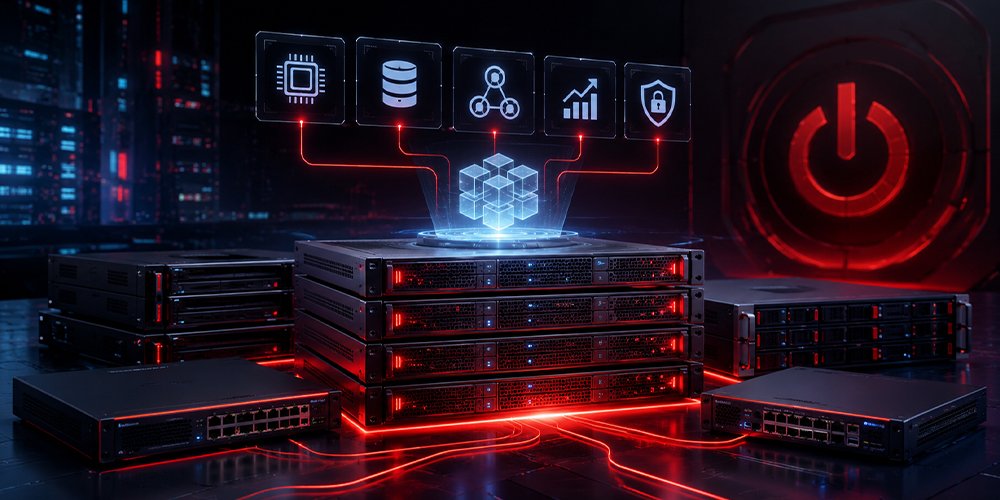
Modern businesses need IT infrastructure that is powerful, flexible, scalable, and easier to manage. Traditional infrastructure often depends on separate servers, storage systems, switches, and management tools. While this model can still be suitable for many environments, it may become complex as businesses grow, deploy more applications, increase data volume, and require faster scalability.
CITS provides professional HCI solutions in Egypt for organizations that want to simplify infrastructure management, improve scalability, optimize performance, and support modern business workloads.
Hyperconverged Infrastructure, commonly known as HCI, combines compute, storage, and networking capabilities into an integrated software-defined infrastructure. This allows businesses to manage critical infrastructure resources through a more unified and flexible approach.
As HPE HCI partners and Dell HCI partners in Egypt, CITS helps organizations evaluate, design, deploy, integrate, and support hyperconverged infrastructure solutions according to their business needs, applications, workloads, and future growth plans.
Whether your business is modernizing a data center, expanding virtualization, improving disaster recovery, or reducing traditional infrastructure complexity, CITS can help you build an HCI environment that supports long-term digital transformation.
What Is Hyperconverged Infrastructure?
Hyperconverged Infrastructure is an IT architecture that brings together compute, storage, networking, and virtualization resources within a single integrated platform.
Instead of managing servers, storage arrays, and networking components as separate infrastructure layers, HCI allows these resources to work together through a software-defined model.
In a traditional environment, businesses may need separate systems for servers, SAN storage, switches, storage management, virtualization, and backup integration. This can increase complexity, require more specialized administration, and make scaling more difficult.
With HCI, infrastructure resources are combined and managed more centrally. This can help businesses simplify operations, deploy new workloads faster, and expand resources more efficiently when demand increases.
HCI can support different workloads, including:
- Virtual machines
- Business applications
- Databases
- ERP systems
- CRM systems
- File services
- Backup and disaster recovery
- Remote office infrastructure
- Private cloud environments
- Data center modernization
- Testing and development environments
- Branch office workloads
The right HCI design depends on the organization’s applications, users, performance requirements, storage capacity, availability targets, and future scalability needs.
Why Businesses Use HCI
Businesses choose hyperconverged infrastructure because it can reduce the complexity of managing separate infrastructure components.
In many traditional environments, IT teams must manage servers, storage systems, storage networks, virtualization platforms, and multiple management tools separately. This can make infrastructure more difficult to monitor, troubleshoot, expand, and secure.
HCI helps simplify this model by consolidating infrastructure layers and providing a more unified management experience.
Organizations may use HCI to achieve:
- Simpler infrastructure management
- Faster deployment of new workloads
- Easier scalability
- Better resource utilization
- Reduced operational complexity
- Improved infrastructure visibility
- More flexible data center expansion
- Support for virtualization
- Improved business continuity planning
- Streamlined IT operations
HCI is especially useful for businesses that want to modernize their data center, standardize infrastructure, support virtualized workloads, or create a more scalable platform for future growth.
Dell HCI Partners in Egypt
Dell HCI solutions can help businesses build scalable and efficient infrastructure environments for virtualization, data center modernization, application hosting, and business continuity.
CITS provides Dell HCI solutions in Egypt for organizations that need integrated compute, storage, networking, and virtualization capabilities.
Dell HCI platforms can support a wide range of business workloads depending on the selected configuration, including virtual machines, databases, enterprise applications, backup workloads, and private cloud environments.
Our team helps businesses evaluate the required hardware specifications, storage capacity, processing power, memory, network connectivity, redundancy, and virtualization requirements before recommending the suitable Dell HCI solution.
The objective is to provide an infrastructure platform that supports current operations while allowing the organization to scale as business needs increase.
HPE HCI Partners in Egypt
HPE HCI solutions can support organizations that want to simplify infrastructure, improve agility, and modernize their IT environments.
As HPE HCI partners in Egypt, CITS helps businesses assess, design, and implement HPE hyperconverged infrastructure solutions according to their workload and operational needs.
HPE HCI can be used for virtualization, business applications, branch infrastructure, data center workloads, backup environments, and scalable infrastructure projects.
Selecting the right HPE HCI configuration requires careful evaluation of compute requirements, storage needs, network design, software stack, redundancy, and expected growth.
CITS works with each organization to identify the suitable HPE HCI approach and support the implementation process from planning to deployment.
VMware HCI Solutions
VMware plays an important role in many virtualized and hyperconverged infrastructure environments.
CITS helps businesses evaluate VMware HCI solutions for workloads that require virtualization, centralized management, resource optimization, and scalable data center operations.
VMware-based HCI can help organizations run multiple virtual machines, manage compute and storage resources, support application workloads, and simplify infrastructure administration.
Before implementing a VMware HCI environment, businesses should evaluate factors such as:
- Number of virtual machines
- Application requirements
- Required storage capacity
- Storage performance
- Memory requirements
- Processor requirements
- Network connectivity
- Backup and recovery needs
- Licensing considerations
- High availability requirements
- Future expansion
CITS helps businesses plan VMware HCI deployments according to technical requirements and operational goals.
HCI for Virtualization
Virtualization is one of the most common use cases for hyperconverged infrastructure.
Many organizations run several virtual machines across their infrastructure to support applications, databases, internal systems, file services, and business operations.
HCI can help simplify virtualization by combining the infrastructure resources needed to run virtual machines into a more unified platform.
This may help businesses reduce the need for separate storage arrays and simplify the way virtualized workloads are managed.
HCI for virtualization can support:
- Server consolidation
- Application hosting
- Database environments
- Development and testing workloads
- Remote office workloads
- Private cloud platforms
- Resource scaling
- High availability
- Disaster recovery planning
The right HCI solution should be sized according to the real workload. Processor capacity, memory, storage performance, usable capacity, network throughput, and redundancy must all be considered.
HCI for Data Center Modernization
Data centers often grow over time through multiple hardware purchases, different generations of equipment, and separate management systems. This can make infrastructure difficult to manage and expand.
HCI can help organizations modernize their data centers by providing a more integrated and software-defined infrastructure model.
Instead of building every infrastructure layer separately, businesses can deploy HCI nodes and scale resources as requirements grow.
HCI can support data center modernization by helping organizations:
- Reduce infrastructure complexity
- Standardize hardware and management
- Improve scalability
- Support virtualized workloads
- Simplify expansion
- Improve operational visibility
- Reduce manual administration
- Support private cloud initiatives
- Prepare for future digital services
CITS helps businesses evaluate whether HCI is the right modernization path based on their applications, existing infrastructure, budget, and long-term IT strategy.
HCI for Backup and Disaster Recovery
Business continuity is an important consideration for any IT infrastructure.
Organizations need to protect their applications and data against hardware failure, accidental deletion, cyber incidents, software errors, and unexpected outages.
HCI can support backup and disaster recovery strategies by providing a flexible infrastructure platform for running workloads and managing resources.
Depending on the solution design, HCI environments may support replication, high availability, snapshot-based protection, backup integration, and recovery planning.
However, HCI should not be considered a complete backup strategy by itself. Businesses still need a clear backup and disaster recovery plan that defines:
- Which workloads must be protected
- Backup frequency
- Retention requirements
- Recovery time objectives
- Recovery point objectives
- Offsite or cloud backup requirements
- Testing and validation procedures
- Security and access controls
CITS helps organizations design HCI environments that can integrate with their broader backup and disaster recovery requirements.
HCI for Remote Offices and Branches
Businesses with multiple branches often need reliable infrastructure at remote locations.
Traditional branch infrastructure may require separate servers, storage, backup devices, and management tools at each site. This can increase cost and complexity.
HCI can help simplify remote office and branch infrastructure by combining essential resources into a more compact and manageable platform.
Branch HCI deployments can support:
- Local applications
- File services
- Virtual machines
- Backup workloads
- Remote office systems
- Centralized management
- Business continuity
- Simplified maintenance
The right branch HCI solution depends on the number of users, applications, local data requirements, connectivity to headquarters, and availability needs.
CITS helps businesses evaluate whether HCI is suitable for branch environments and how it should be integrated with the wider corporate infrastructure.
Software-Defined Infrastructure
HCI is closely related to the concept of software-defined infrastructure.
In a software-defined model, infrastructure resources are managed through software rather than relying only on separate hardware configuration.
This can make infrastructure more flexible, easier to automate, and simpler to scale.
Software-defined infrastructure can help organizations manage compute, storage, networking, and virtualization resources in a more unified way.
For businesses that want to move toward a software-defined data center, HCI can provide a practical foundation.
CITS helps organizations understand how HCI fits within their broader infrastructure and digital transformation plans.
Scalability and Flexibility with HCI
One of the major advantages of HCI is scalability.
In traditional infrastructure, expanding capacity may require separate upgrades for servers, storage arrays, switches, and management tools. This can create planning complexity and compatibility concerns.
With HCI, organizations can often scale by adding nodes or expanding resources within the platform, depending on the selected solution.
This helps businesses respond to growth in users, applications, virtual machines, data volume, and performance requirements.
Scalability planning should consider:
- Current workload
- Expected workload growth
- Number of virtual machines
- Required compute resources
- Required memory
- Required storage capacity
- Required storage performance
- Network bandwidth
- Licensing requirements
- Future business expansion
CITS helps businesses plan HCI scalability from the beginning so the solution can support both current and future requirements.
HCI Performance Considerations
A successful HCI deployment requires correct sizing.
If the solution is undersized, applications may experience slow performance, storage bottlenecks, or limited capacity. If the solution is oversized, the business may spend more than necessary.
CITS evaluates the workloads that will run on the HCI platform before recommending a configuration.
Performance planning may include:
- Processor requirements
- Memory requirements
- Storage type
- Storage performance
- Network speed
- Number of virtual machines
- Application type
- Database load
- Backup activity
- Redundancy requirements
- Growth expectations
Performance should be evaluated based on real business workloads, not only on generic hardware specifications.
HCI Integration with Existing Infrastructure
Many businesses do not replace their entire infrastructure at once.
A new HCI environment may need to work alongside existing servers, storage systems, switches, firewalls, backup platforms, applications, and security policies.
CITS helps organizations integrate HCI into their current infrastructure with minimum disruption.
Integration planning may include:
- Network connectivity
- VLAN configuration
- Firewall policies
- Backup integration
- Virtual machine migration
- Storage migration
- User access requirements
- Monitoring tools
- Security controls
- Management access
- Testing and validation
A careful integration plan helps businesses adopt HCI while maintaining continuity for existing systems.
HCI Deployment Services
CITS provides end-to-end HCI deployment services in Egypt.
Our services can include:
- Infrastructure assessment
- Workload evaluation
- Solution design
- Vendor and platform selection
- Hardware sizing
- Storage and compute planning
- Network design
- Virtualization planning
- Installation and configuration
- Migration support
- Backup and disaster recovery integration
- Testing and validation
- Documentation
- Maintenance and support
Each deployment is planned according to the organization’s environment and operational requirements.
The goal is to deliver a stable HCI platform that supports business workloads and simplifies infrastructure management.
HCI Support and Maintenance
After deployment, HCI environments require monitoring, maintenance, and periodic review.
As business requirements change, the infrastructure may need resource expansion, configuration updates, performance optimization, or additional integration.
CITS provides support and maintenance services for HCI environments, including troubleshooting, configuration review, expansion planning, performance assessment, and technical consultation.
Ongoing support helps organizations keep their HCI platform stable, secure, and aligned with business requirements.
How CITS Selects the Right HCI Solution
Every business has different infrastructure requirements.
Before recommending an HCI solution, CITS evaluates factors such as:
- Existing infrastructure
- Number of users
- Number of virtual machines
- Application workloads
- Database requirements
- Storage capacity
- Storage performance
- Processor and memory needs
- Network design
- Backup and recovery requirements
- Availability targets
- Branch requirements
- Data center strategy
- Future scalability
- Budget requirements
This assessment helps determine the appropriate platform, configuration, and implementation approach.
CITS focuses on recommending a solution that is practical, scalable, and aligned with the organization’s long-term IT goals.
Why Choose CITS for HCI Solutions in Egypt?
CITS provides complete IT infrastructure solutions covering servers, storage, switching, security, wireless networks, structured cabling, spare parts, CCTV, and hyperconverged infrastructure.
This broad infrastructure experience allows our team to understand how HCI connects with the wider IT environment.
As HPE HCI partners and Dell HCI partners in Egypt, CITS can help businesses evaluate leading HCI technologies and select the solution that best matches their needs.
Our approach focuses on understanding the customer’s business objectives, assessing current infrastructure, designing a suitable architecture, supporting implementation, and providing ongoing technical support.
Whether your organization is upgrading traditional infrastructure, expanding virtualization, modernizing a data center, or planning a scalable private cloud environment, CITS can help you take the next step with confidence.
Get a Quote for HCI Solutions in Egypt
Hyperconverged infrastructure can help businesses simplify IT operations, improve scalability, and build a more flexible foundation for future growth.
Contact CITS to discuss your HCI requirements and receive a suitable recommendation based on your workloads, applications, virtual machines, storage needs, network infrastructure, availability requirements, and growth plans.
Our team can help you evaluate Dell HCI, HPE HCI, and VMware HCI solutions in Egypt and select the right platform for your organization.
Frequently Asked Questions
What is HCI?
HCI stands for Hyperconverged Infrastructure. It is an IT infrastructure model that combines compute, storage, networking, and virtualization resources into an integrated software-defined platform.
What is the difference between HCI and traditional infrastructure?
Traditional infrastructure often uses separate servers, storage systems, and network components. HCI combines these resources into a more integrated platform with centralized management and easier scalability.
Does CITS provide HCI solutions in Egypt?
Yes. CITS provides HCI solutions in Egypt, including assessment, design, deployment, integration, migration support, maintenance, and technical consultation.
Does CITS provide Dell and HPE HCI solutions?
Yes. CITS provides Dell HCI and HPE HCI solutions in Egypt according to customer workloads, infrastructure requirements, and business objectives.
Can HCI support virtualization?
Yes. HCI is commonly used for virtualization environments and can support multiple virtual machines, applications, databases, and private cloud workloads when properly sized.
Is HCI suitable for small businesses?
HCI can be suitable for some small and medium-sized businesses, especially when they need simplified infrastructure, virtualization, branch systems, or scalable growth. The suitability depends on workload, budget, and future plans.
Can HCI help with data center modernization?
Yes. HCI can help modernize data centers by reducing infrastructure complexity, simplifying management, supporting virtualization, and making expansion more flexible.
Does HCI replace backup?
No. HCI can support backup and disaster recovery strategies, but it does not replace a complete backup plan. Businesses still need separate backup policies, retention rules, recovery planning, and testing.
What information is needed to design an HCI solution?
Important information includes current infrastructure, number of users, virtual machines, applications, databases, storage capacity, performance requirements, network design, backup needs, and future growth expectations.
Does CITS provide HCI support after deployment?
Yes. CITS provides HCI support and maintenance, including troubleshooting, configuration review, performance assessment, expansion planning, and technical consultation.